Product Engineering Practice

From product vision to scalable software, with AI at the core.

We help teams define, build, and scale products — pairing user-centered design and strong engineering with AI-driven capabilities, modular architectures, and an Innovation Lab that compounds speed.

Trusted on programs referenced by IBM · Dedalus · Harris Healthcare
200+
Product engineers
37+
Clients across the globe
15%
Revenue invested in R&D
73%
Net Promoter Score

Trusted by leading enterprises and healthcare teams

Chargeback
Datanuum
Dedalus
Facely
Harris Healthcare
Firetree
ForwardLane
IBM
M2P
Marque
Medworks
Merchantrade
Parthenon
Qodex
Shift
SmartBiz
Sojern
UFG
UrbanSDK
Zero Gravity
Product Challenges

Building scalable products takes the right partner.

Modern product teams juggle discovery, AI, modernization, and scale all at once. These are the challenges we're built to solve — with the right tools, agility, and engineering depth.

01

Embed AI into real user workflows, not bolt it on.

02

Modernize legacy product platforms without disruption.

03

Turn product data into actionable insights.

04

Design API-first, modular product architectures.

05

Define & validate product goals before committing to solutions.

06

Release features through rapid, reliable iterations.

07

Build for cloud-native scalability from day one.

08

Learn from real usage to expand product intelligence.

Core Capabilities

The full product engineering stack.

Everything needed to take a product from idea to scale — design, intelligence, data, and cloud-native engineering, grounded in deep domain expertise.

User-Centered Experience

Discovery, UX research, and product design that ground every decision in real user problems, goals, and data signals.

Product discoveryUX designMVP scoping

AI & Machine Learning

Embed AI and ML into real workflows — from predictive scoring to generative capabilities — so intelligence drives the product, not the demo.

ML modelsGenerative AIAI in workflows

Data Layer & Insights

Turn product data into actionable insights — clean data foundations, analytics, and feedback loops that expand product intelligence.

Data platformsAnalyticsUsage insights

Cloud-Native Scalability

Architect for elastic scale from day one — resilient, observable, cloud-native systems that grow with workload, not headcount.

AWS · Azure · GCPMicroservicesObservability

API-First Product Engineering

Modular, API-first architectures and strong engineering practices that enable rapid iteration and clean integration.

API-firstModular designCI/CD

Domain Expertise

Deep experience across Healthcare, BFSI, and Life Sciences — so engineering decisions are informed by the realities of your industry.

HealthcareBFSILife Sciences
How We Deliver

From discovery to governance — a strategic path.

A structured path that connects product strategy to engineering, business value, and a forward roadmap — built with speed, clarity, and AI at the core.

Phase 01

Discovery

Work closely with product and business stakeholders to understand the core problem, target users, and success criteria before development begins.

Phase 02

Initial Architecture

Define the system architecture, technology stack, data flows, and AI readiness to ensure scalability, security, and long-term product evolution.

Phase 03

AI-Driven Development

Build product features iteratively, embedding AI where it delivers real value — automation, intelligence, personalization, and actionable insights.

Phase 04

UAT & MVP Release

Conduct User Acceptance Testing and deliver a usable MVP within the first few months, focused on essential features and early user feedback.

Phase 05

Ongoing Maintenance

Support long-term growth through monitoring, performance optimization, structured releases, and continuous improvement driven by real usage.

What is changing

The spec stopped surviving contact with production.

Product engineering ran for two decades on a clean handoff. Requirements went in one end, releases came out the other, and the customer appeared at UAT. That worked while the unknowns lived in the interface.

Once AI moved into the product, the unknowns moved into the customer's data. Their document variants. Their exception paths. The field that three departments populate differently. The claim that fails on a payer rule nobody documented. None of that is recoverable from a discovery call — it is only recoverable from a deployment.

Forward Deployed Engineer

A production engineer who works inside the customer's environment, sees what actually breaks against real data, and merges the fix into your product — rather than writing it up and filing it behind a quarter of backlog.

What changes in practice

Six dimensions of the delivery model

Where requirements come from

Handoff model
Stakeholder interviews, then a signed specification.
Forward deployed
Instrumented traces from the customer's live workflow.

When the spec is written

Handoff model
Before the first line of code is written.
Forward deployed
After the first deployment, from observed failure.

Who holds the context

Handoff model
A product manager who relays it second-hand.
Forward deployed
The engineer who writes and merges the fix.

Feedback latency

Handoff model
One release cycle — weeks, often a quarter.
Forward deployed
Same day, in the environment where it failed.

What happens to edge cases

Handoff model
Backlog, then a per-customer branch nobody wants to own.
Forward deployed
Generalised into the platform, or explicitly refused.

The definition of done

Handoff model
Features shipped against the roadmap.
Forward deployed
First correct output in production — then repeatable.

The demo is no longer the hard part

A working prototype now takes days. The distance between that prototype and something a regulated customer will run unsupervised is where programmes stall — and it is almost entirely made of their data, not your code.
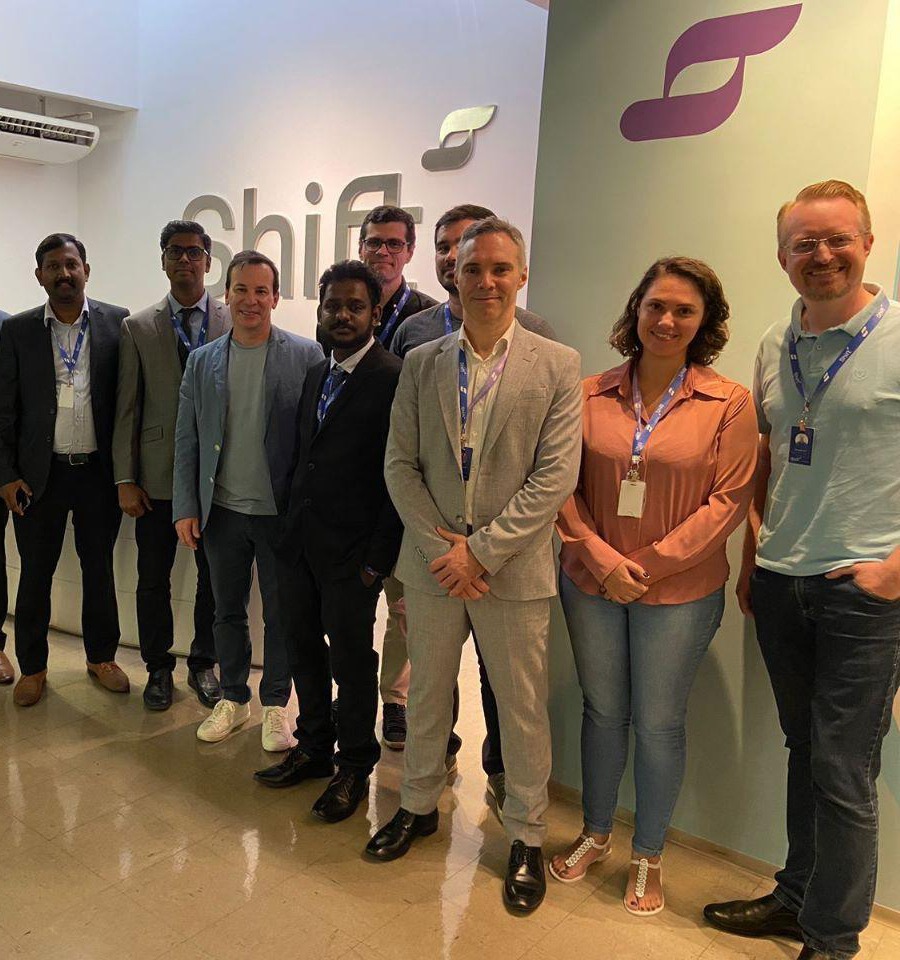

Context is the scarce input

Engineering capacity is no longer the constraint on AI features. Knowing which of the customer's fourteen exception paths actually matters is. That knowledge does not survive a handoff document.

Every custom fix is a fork risk

Customer-specific patches quietly become customer-specific branches, and the cost lands on the platform team eighteen months later. Forward deployment only works with a standing rule for what goes back into core.

We run this model as a named practice.

How our forward deployed engineers are staffed, what they own inside your release train, and how we stop customer work from forking your product.

Forward Deployed Engineering
Innovation Lab

10% of our team, building what's next.

We invest 10% of our team in Innovation Labs to stay ahead of market trends, accelerate delivery, and proactively build reusable solutions — so clients start with roughly 30% of the work already done.

AI / ML Adoption

Frameworks for knowledge bases, fraud detection, predictive scoring, and medical coding (CAC).

Legacy Modernization

Migration accelerators for PowerBuilder, MS Access, Oracle Forms, and mainframe apps.

Unified Data Platform

Standardized data lakes & marts with built-in connectors for EHRs, CRMs, and core banking.

Cloud Migration

Templates for GCP, AWS, and Azure with built-in cost optimization modules.

Microservices & APIs

Internal scaffolding to generate API templates with observability built in.

CheiAI × IBM
Accelerated Value Program

AI acceleration delivered on programs referenced by IBM.

CheiAI × BEC Group
AI for Construction

An AI product purpose-built for construction development workflows.

CheiAI × UrbanSDK
Bay Area Platform

A platform customized for a Bay Area startup.

Governance — People · Process · Technology

How we keep delivery predictable at scale.

Productive performance in a short span of time comes from clear ownership. Every engagement runs on a governance model with named accountability across people, process, and technology.

'A' Team

A rapid-response team with elite qualifications that resolves critical issues fast, minimizing downtime and risk.

Owner · R&D Head / CTO

War Room Strategy

Real-time collaboration and adaptive planning that keep responses swift as project dynamics change.

Owner · Head of Delivery & Engineering

Executive Summary

Continuous review of objectives and outcomes to keep work aligned with strategic goals and informed decisions.

Owner · Head of Delivery & Engineering

Risk Management

Continuous risk assessment and mitigation to identify and address threats proactively.

Owner · Head of Global Client Relationship

Client Relationship

Transparent communication with sponsors and executives through bi-weekly, monthly, and quarterly reviews.

Owner · Head of Global Client Relationship

Technology Integration

A seamless integration framework that adopts new technologies with minimal disruption.

Owner · R&D Head / CTO
Proof, not promises

Products we have shipped — and the outcomes.

Every engagement follows the same problem → solution → measurable impact arc. Here are three shipped products across healthcare and fintech.

FAQ

Product Engineering, answered.

Common questions about product engineering, AI integration, MVP timelines, scaling, and our Innovation Lab.

What's the difference between product engineering and staffing developers onto our roadmap?
Product engineering goes beyond software development by including product discovery, user experience validation, architecture planning, AI and ML integration, data design, and cloud architecture before development begins. Staffing developers simply provides engineering resources to execute predefined tasks, while a product engineering partner helps shape the product, identify risks, and improve outcomes throughout the development lifecycle.
How do you embed AI into a product without it feeling bolted on?
AI is integrated into the product from the discovery and design phases rather than being added after development. By identifying opportunities for intelligent automation, predictive analytics, and workflow optimization early in the architecture process, AI becomes a natural part of the user experience and business workflow instead of an isolated feature.
How fast can we realistically get an MVP to market?
Following discovery, product planning, and architecture, a functional MVP can typically be delivered within the first few months. The exact timeline depends on the product's complexity, technical requirements, and the level of clarity around business goals and feature priorities.
Can this team also handle scaling an existing product, not just building new ones?
Yes. Product engineering services support both new product development and the modernization and scaling of existing applications. This includes cloud-native architecture, API-first design, performance optimization, and infrastructure improvements that enable products to grow with increasing users and business demands.
What is the Innovation Lab, and how does it reduce project cost?
The Innovation Lab invests engineering time in building reusable accelerators such as migration frameworks, cloud optimization components, integration connectors, and development templates. These reusable assets reduce implementation effort, shorten delivery timelines, and lower overall project costs by minimizing repetitive foundational work.
Talk to our CTO

Start with a thirty-minute conversation.

No 50-page proposals. We'll tell you which level fits your situation, what a realistic engagement looks like, and what it would cost — in one direct meeting.

Who you'll talk to
Thomas, CTO at 10decoders

Thomas

Chief Technology Officer

Connect on LinkedIn

Thomas leads 10decoders' AI engineering practice and sits in on the scoping call himself — so the person mapping your engagement is the one who has shipped it before. His teams build and deploy agents for mid-market healthcare and fintech companies, with enterprise grade build experience for clients like IBM, Dedalus and Harris Healthcare. He'll be straight with you about what's worth doing and what isn't.

200+
Engineers
37+
Global Clients
ISO
27001 / 9001
Partner Program

Love what we're doing? Want to partner and sell our products or services?

Explore partner programs →

Send us an inquiry

Three fields. We'll reply within one business day.